How Are AI Ads Changing the Way Brands Create and Optimize Campaigns?
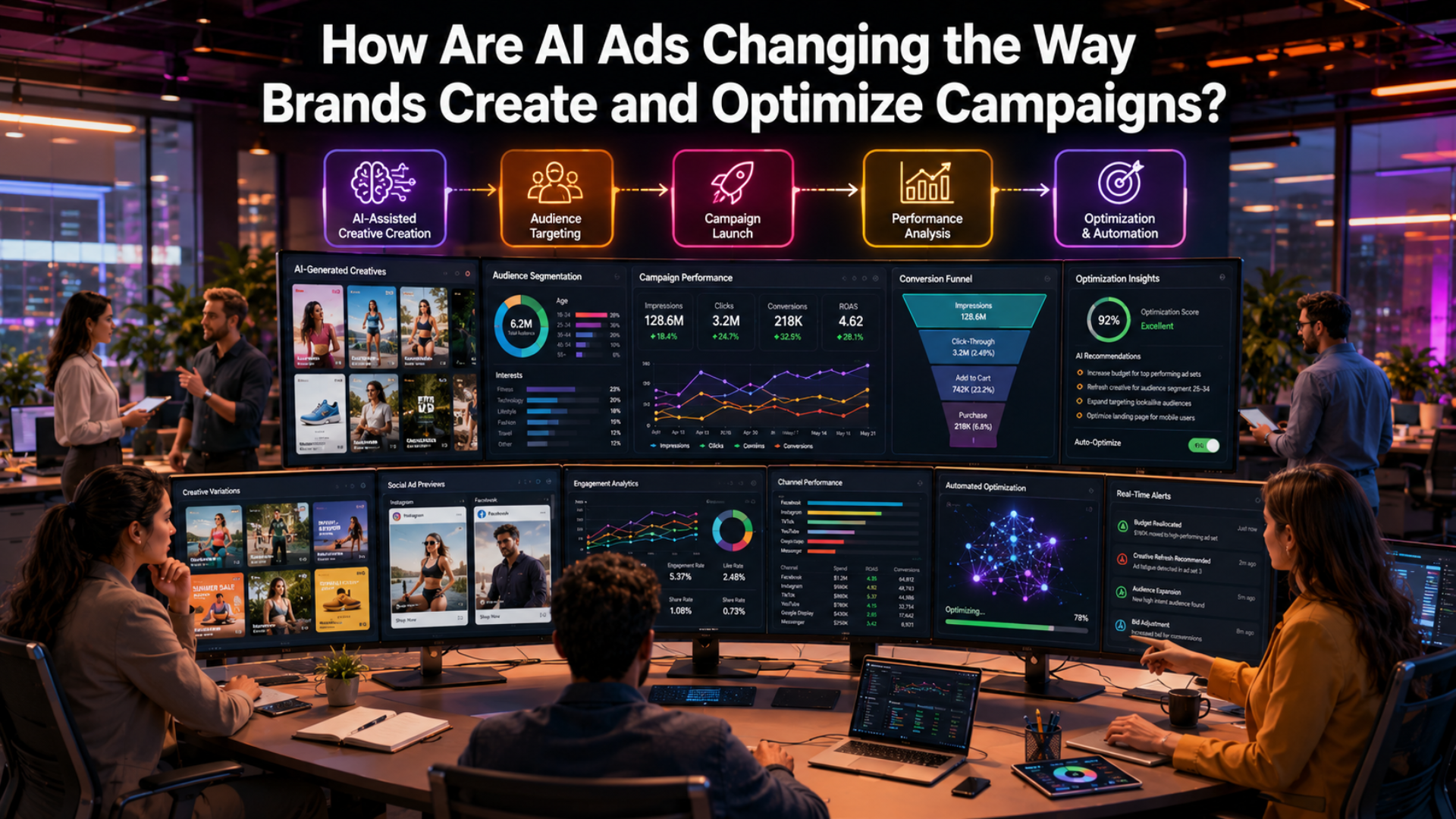
What if creating, launching, and improving an advertising campaign could happen in a fraction of the time it once required? AI ads are changing digital advertising by helping marketers automate creative production, analyze audience behavior, personalize messaging, and optimize campaigns using data-driven insights.
The short answer is yes: artificial intelligence can make advertising more efficient by identifying patterns in large datasets and using those insights to support decisions about creative assets, audiences, placements, and campaign performance. Instead of replacing marketers entirely, AI can reduce repetitive work and give teams more time to focus on strategy and creativity.
What makes AI-powered advertising different?
Traditional advertising often depends on manually developing several creative concepts, selecting audiences, monitoring results, and making adjustments. ***[AI ads](https://adsgpt.io/blog/ai-ads-are-underperforming-heres-the-real-fix/
)*** introduce automation into many of these steps.
Modern advertising platforms can analyze signals such as:
* Audience interests and behaviors
* Previous engagement
* Conversion activity
* Creative performance
* Search and browsing patterns
* Device and placement information
* Campaign objectives and historical results
These insights can help marketers identify which combinations of audiences, messages, formats, and placements are more likely to achieve specific objectives.
The result is a more responsive advertising process in which campaign decisions can be influenced by continuously changing performance data.
Can AI improve advertising personalization?
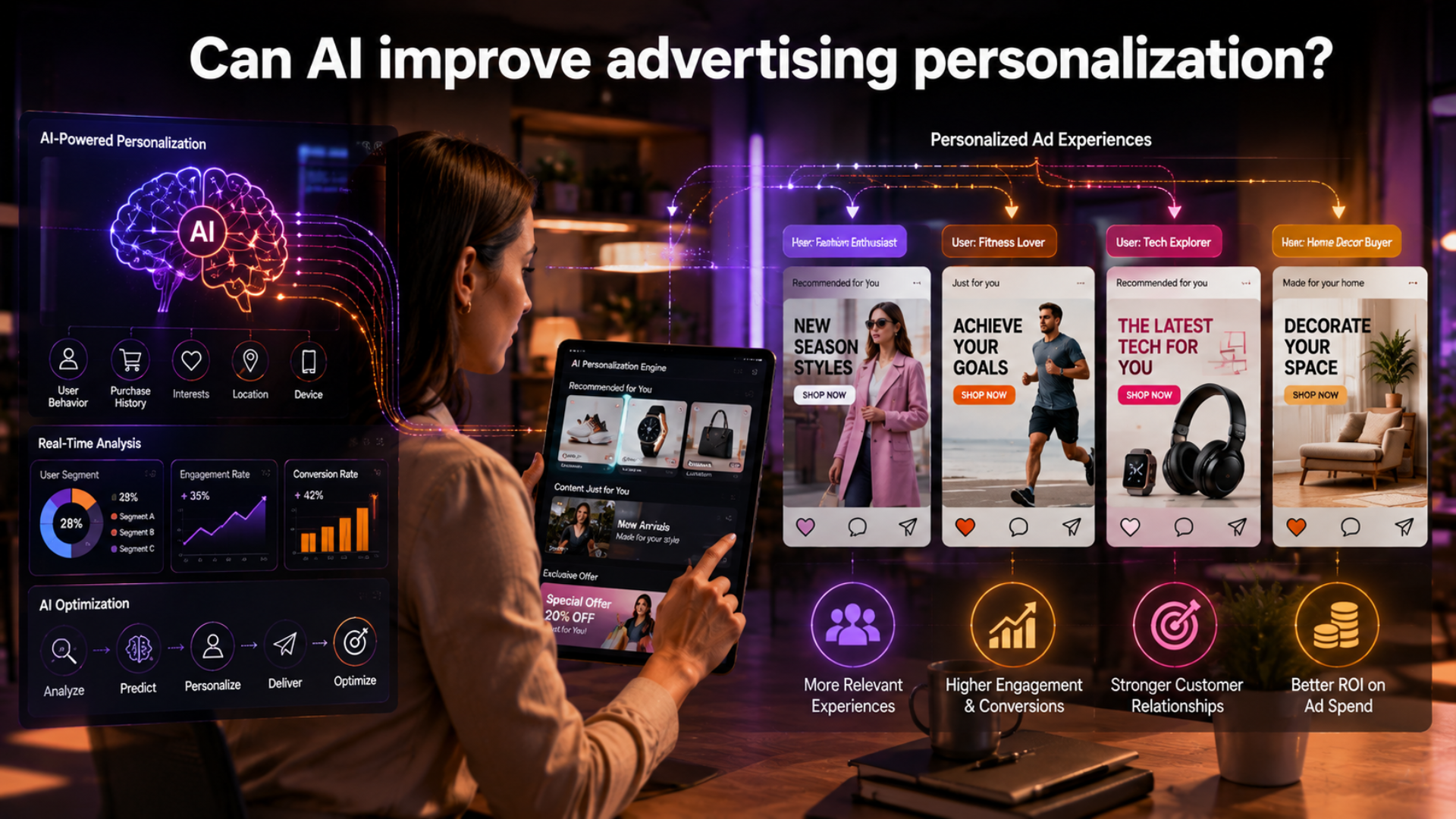
Personalization is one of the most important opportunities created by intelligent advertising systems. Different customers can respond to different messages even when they are interested in the same product.
AI can help advertisers identify patterns among audience segments and adapt messaging accordingly. A campaign might emphasize convenience for one group, product features for another, and promotional value for a third.
Effective personalization should remain useful rather than intrusive. Marketers should avoid using unnecessarily sensitive information or creating experiences that make consumers uncomfortable.
Good personalization answers a simple question: Does this message make the advertisement more relevant to the person seeing it?
How can an AI maker help advertisers create campaigns?
An ***[AI maker](https://adsgpt.io/blog/ai-maker-for-content-creation/
)*** can assist with the production of advertising assets, including headlines, descriptions, visual concepts, social media copy, product messaging, and variations of creative content.
This can be especially useful when marketers need multiple versions of an idea for different audiences or platforms. Instead of starting every variation from scratch, teams can use AI-assisted workflows to generate initial concepts and then refine them according to brand guidelines.
For example, an ecommerce company promoting a new product might develop different messages emphasizing affordability, convenience, durability, or premium quality. AI can help create variations quickly, while human marketers determine which messages accurately represent the brand.
The strongest approach combines automation with human judgment. AI can generate and analyze options, but people remain responsible for brand voice, factual accuracy, positioning, ethical considerations, and final approval.
How does AI help optimize creative performance?
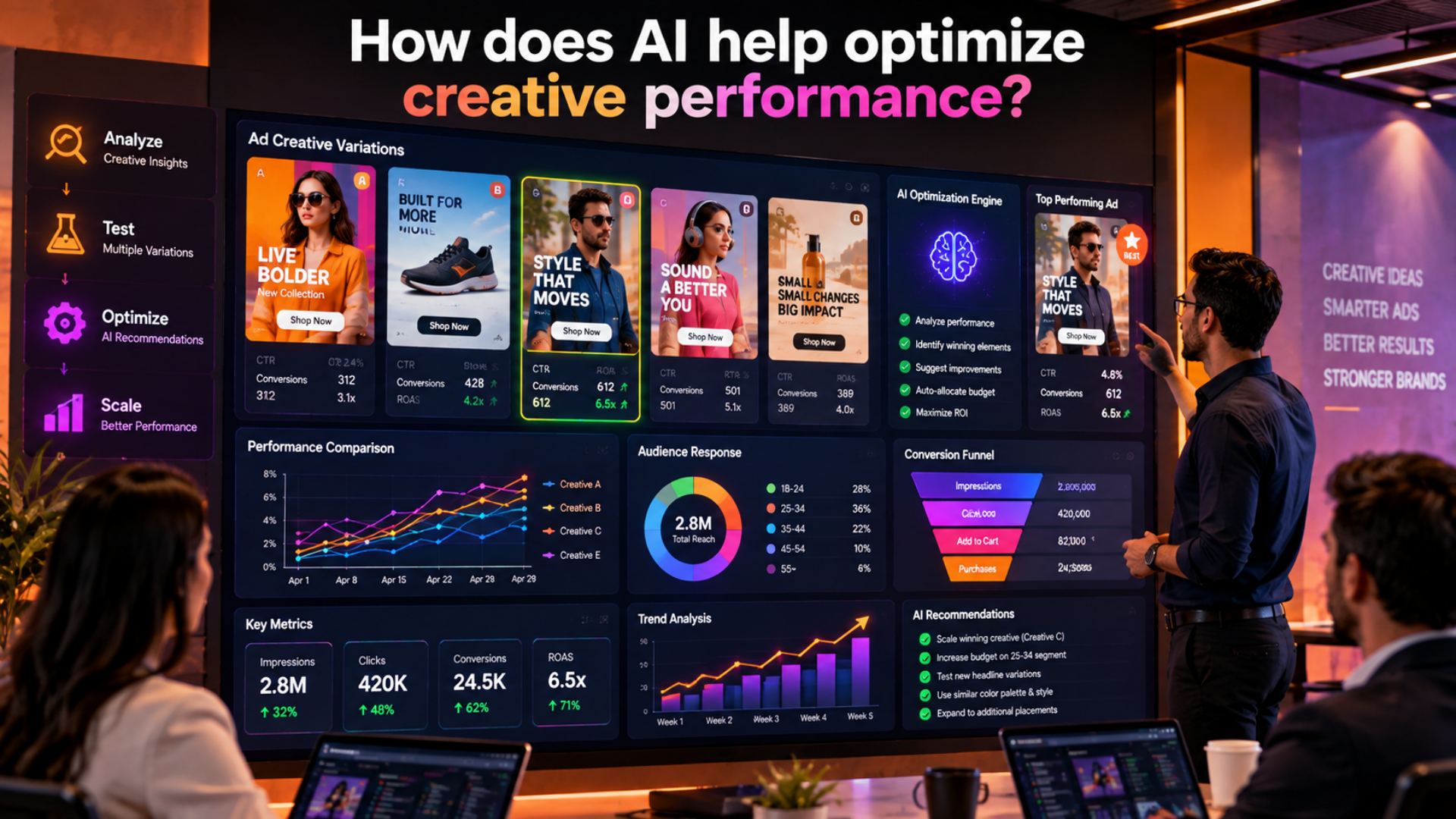
Creative optimization involves continuously evaluating which advertising elements generate useful results. AI can process performance information much faster than manual analysis.
It can help marketers compare variables such as:
1. Headlines
2. Images and videos
3. Calls to action
4. Audience segments
5. Ad placements
6. Landing-page experiences
7. Conversion outcomes
This makes it easier to identify patterns and allocate attention toward stronger-performing combinations.
However, performance data needs context. A creative asset with a high click-through rate is not automatically successful if those clicks fail to produce meaningful conversions. Marketers should evaluate metrics according to the campaign's actual business objective.
What role do Paid Ads play in an AI-driven strategy?
***[Paid Ads](https://medium.com/@creativeaigencom/paid-ads-how-can-businesses-reach-the-right-audience-faster-1f917053dddb?postPublishedType=repub
)*** remain an important way for businesses to reach targeted audiences quickly, and AI can make campaign management more responsive.
Advertising platforms increasingly use machine learning to assist with audience selection, bidding, delivery, creative recommendations, and optimization. Marketers can provide campaign objectives and supporting assets while automated systems help determine where and when advertisements may perform best.
This can be particularly valuable for campaigns with substantial amounts of performance data. As more interactions occur, optimization systems can identify patterns that would be difficult to evaluate manually.
Still, automation should not become an excuse to stop monitoring campaigns. Marketers need to review spending, conversion quality, creative fatigue, audience relevance, and business outcomes regularly.
What are the risks of relying too heavily on AI?
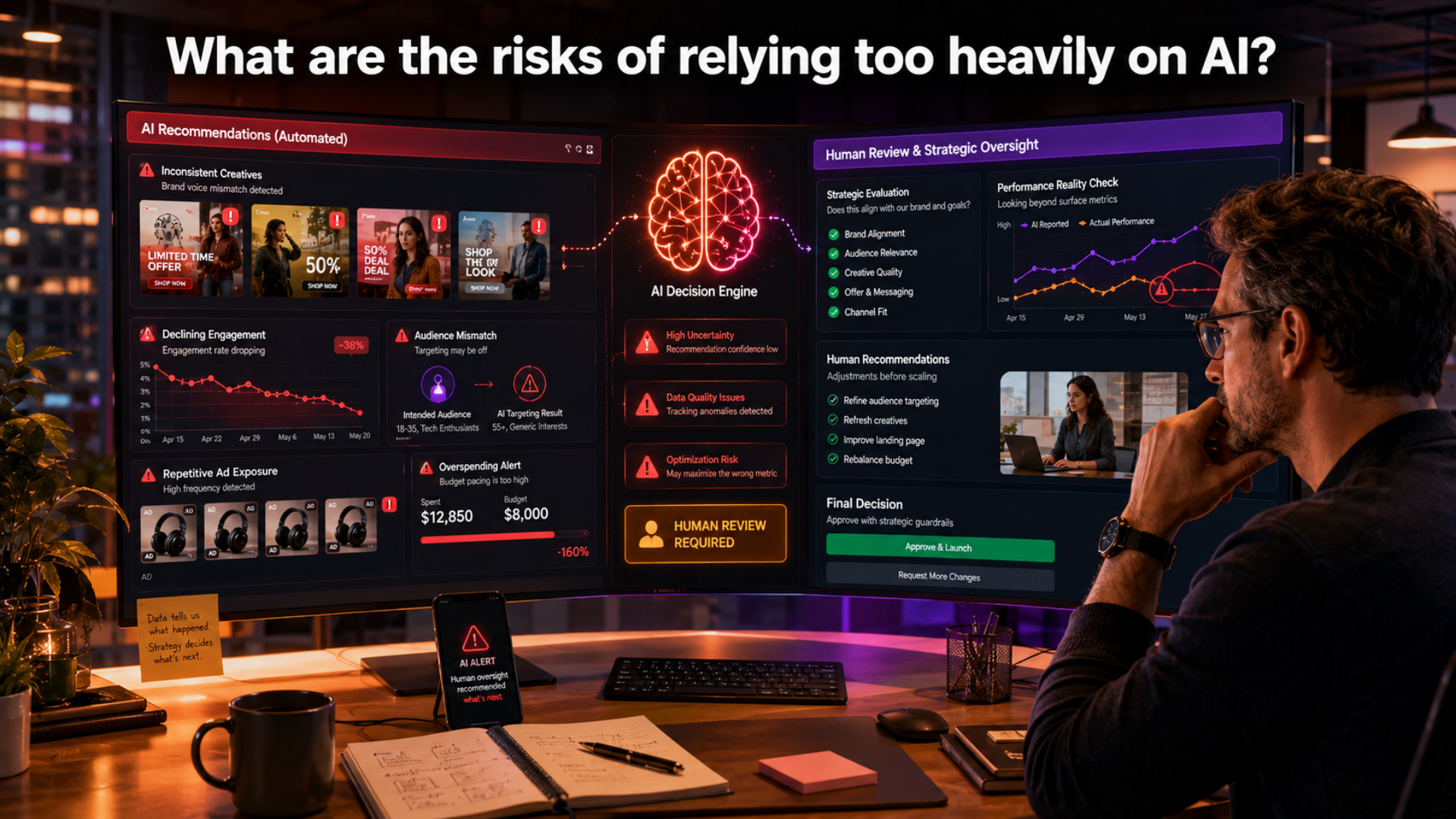
AI can accelerate advertising, but it does not guarantee effective marketing.
Common challenges include:
* Generic creative: Automatically generated content may lack originality.
* Incorrect information: AI-generated claims can require careful verification.
* Brand inconsistency: Uncontrolled variations may drift from established messaging.
* Audience fatigue: Excessive repetition can reduce engagement.
* Poor optimization signals: AI systems can optimize toward the wrong metric when campaign goals are unclear.
* Reduced human oversight: Excessive automation can allow errors to continue unnoticed.
The solution is not to avoid AI. Instead, marketers should establish clear objectives, review outputs, monitor performance, and maintain meaningful human oversight.
How should businesses build an effective AI advertising workflow?
A practical workflow can combine automation with strategic decision-making:
Step 1: Define the objective.
Determine whether the campaign is designed for awareness, traffic, leads, sales, engagement, or another measurable outcome.
Step 2: Understand the audience.
Identify customer needs, pain points, motivations, and purchasing considerations.
Step 3: Generate creative variations.
Use AI-assisted tools to develop multiple concepts while maintaining brand standards.
Step 4: Test systematically.
Compare creative and audience variations using meaningful performance indicators.
Step 5: Analyze quality, not just quantity.
Look beyond clicks and impressions to evaluate conversions, customer value, and overall return.
Step 6: Refine continuously.
Use campaign data to improve future creative, targeting, and messaging.
Why will AI remain important in digital advertising?
The volume of advertising data continues to grow, while consumers expect increasingly relevant experiences. Manually processing every signal and creating every creative variation is difficult at scale.
AI can help marketers handle that complexity by automating repetitive processes, identifying patterns, and supporting faster experimentation. Yet the most effective campaigns are unlikely to depend on automation alone.
Human creativity provides the strategic direction, while intelligent technology can provide speed, scale, and analytical support.
You can also watch: ***[AdGPT Ad Factory: One Pipeline for Your Ad Campaigns](https://youtu.be/2Vah-fE3C40?si=7deTc8oYhcFAShca
)***
Summary
AI is becoming an important part of modern advertising because it can accelerate creative development, support personalization, analyze campaign performance, and assist with optimization. ***[AI ads](https://adsgpt.io/blog/ai-ads-are-underperforming-heres-the-real-fix/
)*** can be most effective when technology and human expertise work together rather than competing with each other.
Businesses that establish clear objectives, maintain strong brand standards, test thoughtfully, and monitor results can use AI to build advertising workflows that are faster, more adaptable, and more focused on measurable outcomes.
Frequently Asked Questions
What are AI ads?
They are advertisements created, personalized, analyzed, or optimized with the assistance of artificial intelligence technologies.
Can AI create complete advertising campaigns?
AI can assist with many campaign components, including creative ideas, copy, audience analysis, and optimization, but human oversight remains important.
Is AI suitable for small businesses?
Yes. Smaller teams can use AI to reduce repetitive creative and analytical work, allowing limited marketing resources to be used more efficiently.
Does AI replace advertising professionals?
AI can automate certain tasks, but strategy, creativity, brand judgment, ethical review, and business decision-making still require human involvement.
How can marketers measure AI-supported campaigns?
They should select metrics based on the campaign objective, such as qualified leads, conversions, revenue, customer acquisition cost, or return on advertising spend.