How Can AI Content Creation Help Brands Produce Better Content at Scale?

Can businesses really produce more useful content without expanding their teams, budgets, and production timelines? AI-powered content creation can help by accelerating research, ideation, drafting, editing, personalization, and content repurposing. However, the strongest results come when artificial intelligence supports human expertise rather than attempting to replace it.
In simple terms, AI content tools analyze prompts, patterns, language, and available information to generate or improve written, visual, audio, and video content. They can help marketers move from a blank page to a workable first draft much faster while allowing human creators to focus on accuracy, originality, strategy, and brand voice.
The goal is not simply to publish more. It is to create more relevant content with greater efficiency and consistency.
What is AI-powered content creation?
***[AI content creation](https://adsgpt.io/blog/7-must-have-ai-content-creation-tools/
)*** refers to using artificial intelligence tools to assist with producing different forms of digital content.
Depending on the platform, these tools can support:
* Blog posts and articles
* Social media captions
* Email campaigns
* Product descriptions
* Video scripts
* Advertising copy
* Images and creative concepts
* Content summaries
* Headlines and content ideas
* Frequently asked questions
For marketers, the biggest advantage is speed. Instead of spending hours generating initial ideas or repeatedly adapting the same message for different channels, teams can use AI to create starting points and variations.
Human review remains important because generated content can contain factual errors, repetitive language, weak reasoning, or messaging that does not fit the intended audience.
How can AI improve the content workflow?
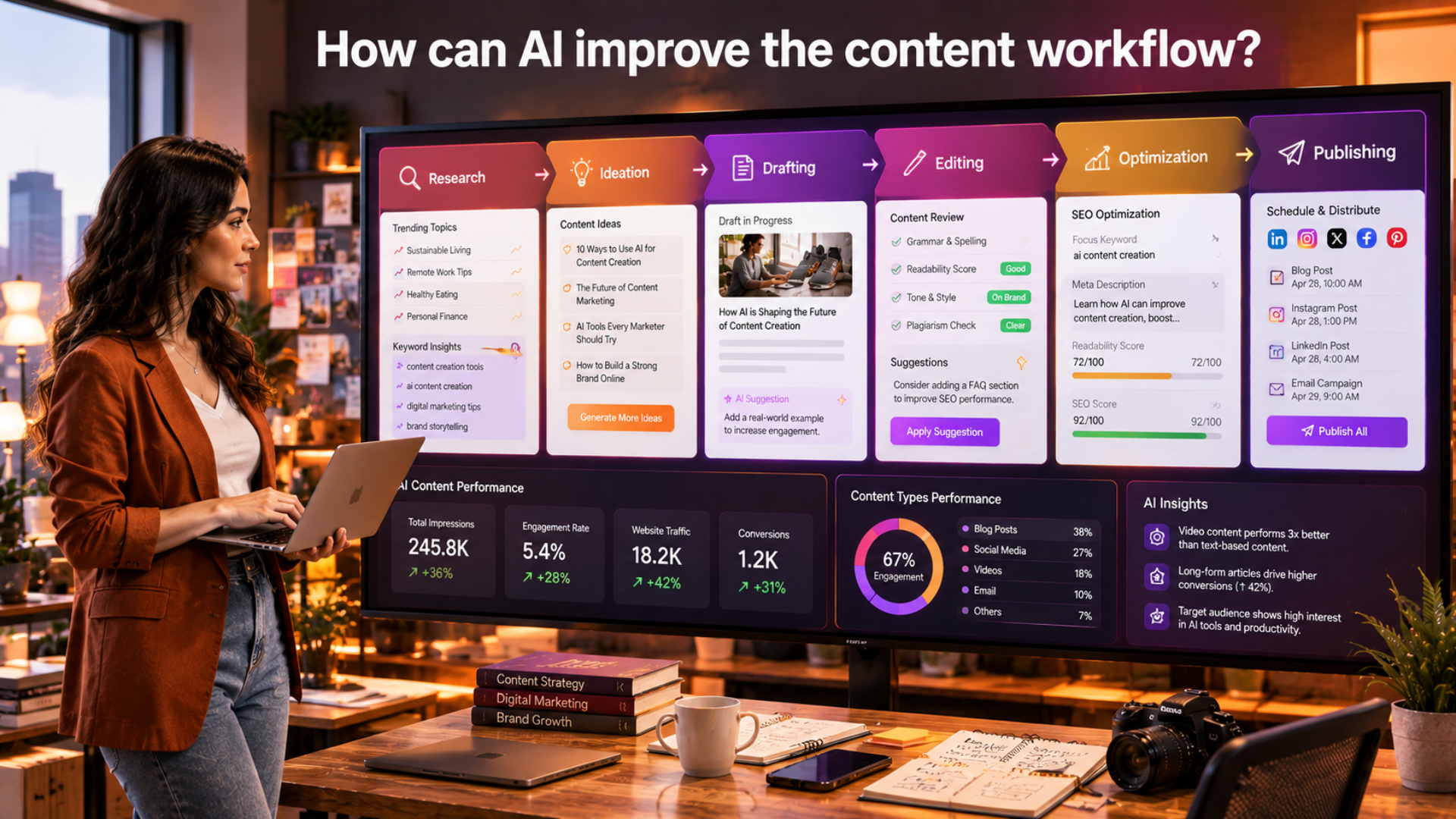
A successful workflow usually begins before the writing stage. AI can assist throughout the content lifecycle rather than being used only as a text generator.
1. Research and topic discovery
AI can help identify potential topics by organizing information around customer questions, industry themes, product features, and common problems.
2. Content ideation
Teams can generate multiple headline concepts, content angles, outlines, questions, and campaign ideas before selecting the strongest direction.
3. Draft development
AI can transform an outline into an initial draft, helping writers overcome repetitive manual work and focus more heavily on expertise and storytelling.
4. Repurposing
A long-form article can become social posts, email ideas, video scripts, summaries, or FAQ content. This makes existing intellectual property more useful across multiple channels.
5. Editing and refinement
AI can assist with grammar, clarity, readability, tone, structure, and consistency, although final editorial judgment should remain with a qualified human.
How should businesses integrate AI into a content marketing strategy?
A strong ***[content marketing strategy](https://adsgpt.io/blog/content-marketing-strategy/
)*** should define the purpose of each piece before AI enters the workflow. Businesses need to understand who they are addressing, what problem they are solving, and what action they want the reader to take.
A practical process can include:
1. Define the target audience and search intent.
2. Establish the brand's tone and editorial standards.
3. Select topics based on customer needs.
4. Use AI for research assistance and ideation.
5. Create a human-reviewed first draft.
6. Add original expertise, examples, evidence, and opinions.
7. Optimize the finished content for readability and search.
8. Measure engagement and business outcomes.
9. Update successful content as audience needs change.
This approach prevents AI from becoming a shortcut that produces large volumes of generic material. Instead, it becomes part of a structured publishing system.
What makes AI-generated content valuable to readers?
Speed alone does not make content valuable. Readers generally want information that is accurate, relevant, understandable, and useful.
High-quality AI-assisted content should therefore provide:
* Clear answers to specific questions
* Original insights rather than generic observations
* Useful examples that explain complex concepts
* Logical organization that makes information easy to scan
* Accurate information supported by appropriate expertise
* A consistent voice that reflects the organization
* Practical guidance readers can actually apply
AI can accelerate production, but human knowledge gives content depth.
How can marketers balance automation with originality?
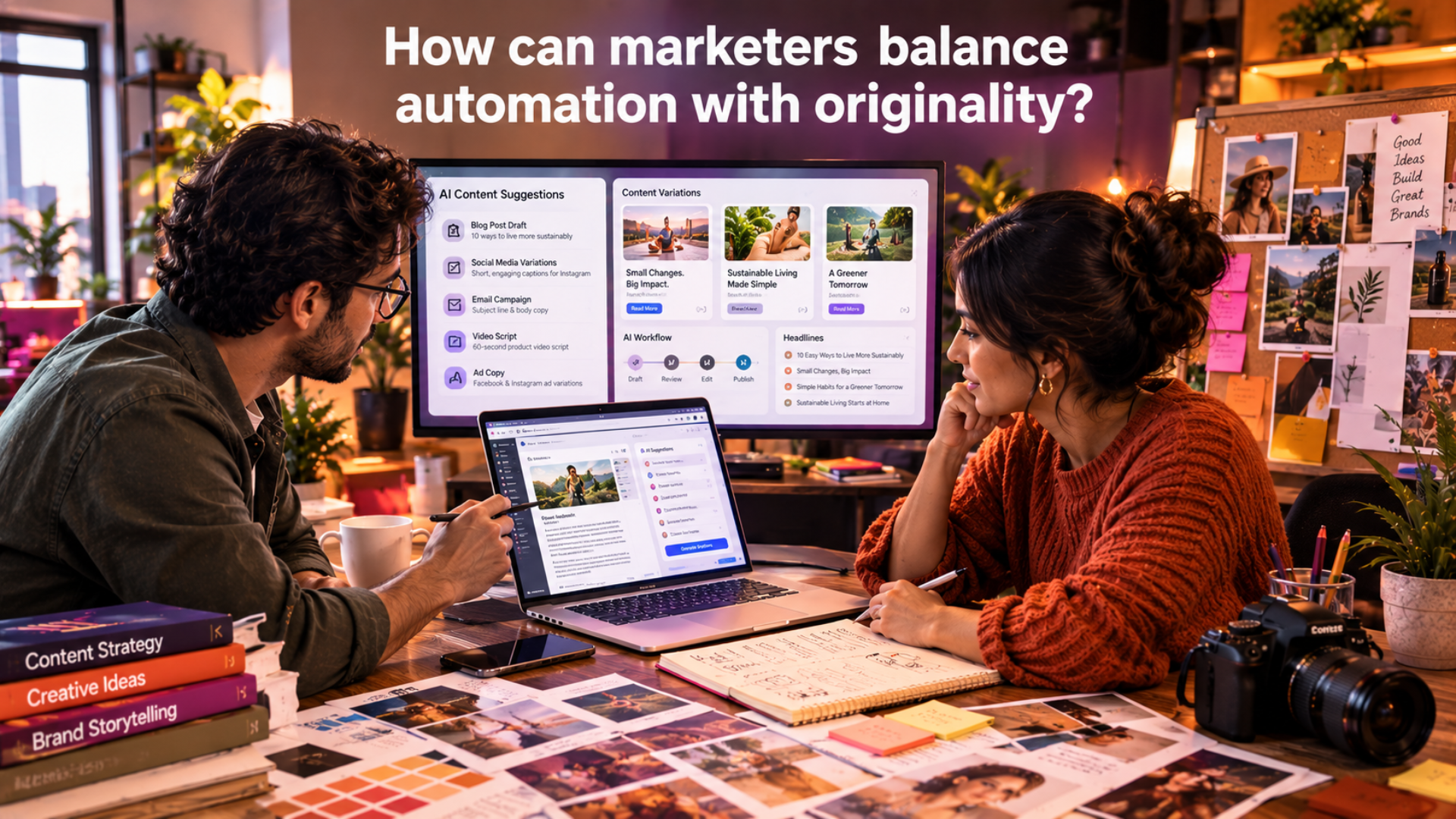
One of the biggest concerns surrounding AI-assisted publishing is sameness. If businesses use identical prompts, templates, and approaches, their content can begin to sound interchangeable.
The solution is to introduce distinctive human inputs.
Creators can improve originality by adding:
* First-hand experiences
* Expert commentary
* Customer stories
* Original research
* Proprietary examples
* Industry-specific observations
* Strong brand opinions
* Unique visual assets
AI should help expand a creator's capabilities, not erase the characteristics that make the brand recognizable.
What are the limitations of AI content tools?
AI-assisted production still has important limitations.
Generated material may sometimes:
* Present incorrect information confidently
* Miss important context
* Repeat common ideas
* Misinterpret a complex request
* Produce an unsuitable tone
* Lack meaningful personal experience
* Require substantial factual editing
There are also broader considerations around originality, intellectual property, privacy, disclosure, and responsible use. Businesses should establish internal guidelines before deploying AI across large content operations.
How do SEO and AI content work together?
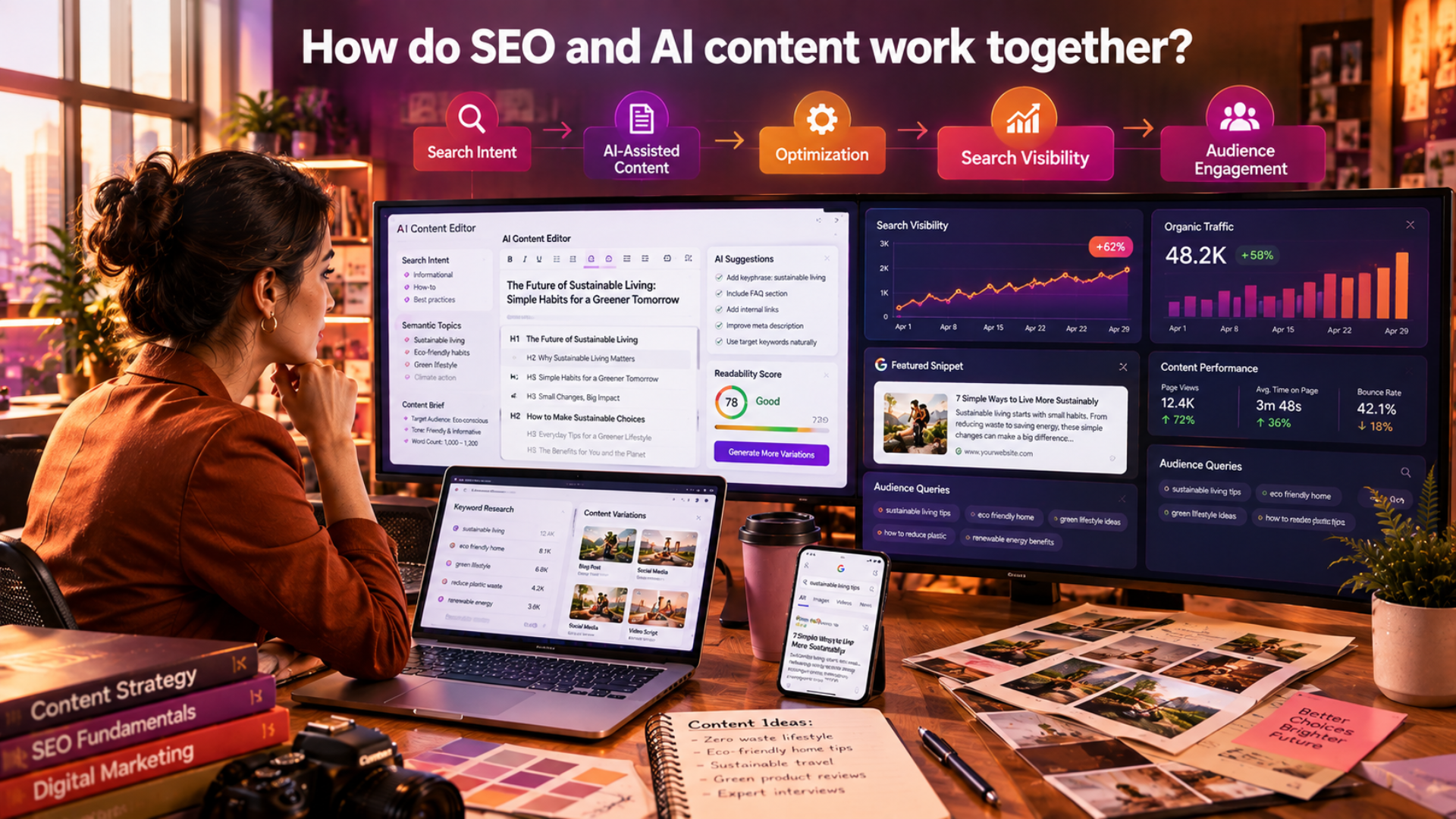
As search behavior becomes increasingly conversational, content needs to answer questions clearly while demonstrating genuine usefulness. ***[SEO and AI content](https://medium.com/@AdGenie/seo-and-ai-content-how-can-artificial-intelligence-improve-search-rankings-797a3eb15de8
)*** can work together when AI assists with topic organization, search-intent analysis, content structuring, semantic coverage, and optimization.
However, search optimization should never become an exercise in inserting keywords repeatedly. Strong content focuses on satisfying the user's question first.
For example, an article targeting an informational query should answer the question near the beginning, explain the topic thoroughly, use descriptive headings, and provide supporting details that help the reader make a decision.
AI can assist with these structural tasks, but humans should determine whether the finished article is accurate, useful, distinctive, and genuinely worth reading.
How can businesses measure AI-assisted content performance?
The best measurement framework goes beyond the number of articles published.
Teams can monitor:
* Organic search visibility
* Engagement and time spent
* Click-through rates
* Conversion rates
* Leads generated
* Returning visitors
* Social engagement
* Content-assisted revenue
* Content update performance
Comparing AI-assisted workflows with previous production methods can also reveal whether automation is genuinely improving efficiency and business outcomes.
Why is human expertise still essential?
AI can generate language quickly, but expertise determines whether that language deserves attention.
Editors, subject-matter specialists, marketers, designers, and strategists provide the context that turns an automated draft into valuable communication. Their role becomes especially important for technical, financial, medical, legal, or other information where accuracy and accountability matter.
The future of content is therefore unlikely to be purely automated. A more practical model combines machine-assisted efficiency with human creativity, judgment, experience, and responsibility.
You can also watch: ***[How to Create Meta Ads with AI | Complete AdsGPT Tutorial](https://youtu.be/ttojt6ZHCnQ?si=qex5ufhE1byU7wby
)***
Summary
***[AI content creation](https://adsgpt.io/blog/7-must-have-ai-content-creation-tools/
)*** can help businesses accelerate ideation, drafting, editing, repurposing, and personalization while reducing repetitive production work. Its real value, however, depends on how thoughtfully it is integrated. Organizations that combine AI efficiency with human expertise, original insights, editorial review, and audience-focused strategy can produce content that is faster to create without becoming generic.
FAQs
What is AI content creation?
It is the use of artificial intelligence to assist with producing or improving written, visual, audio, or video content.
Can AI replace human content writers?
AI can automate parts of the writing process, but human writers remain valuable for expertise, creativity, fact-checking, storytelling, strategic thinking, and editorial judgment.
Is AI-generated content good for SEO?
AI can assist with research, structure, and optimization, but quality depends on whether the final content genuinely satisfies user intent and provides accurate, useful, original information.
How can companies use AI responsibly?
Companies should establish editorial guidelines, review generated material, protect sensitive information, verify factual claims, and maintain human accountability for published content.
What is the biggest advantage of AI-assisted content?
Efficiency is one of the biggest advantages. AI can help teams develop ideas, drafts, variations, and repurposed content much faster while allowing people to concentrate on higher-value creative and strategic work.